
Logotip Ljubljanske Mlekarne
HomeSitemapSlovenščinaHrvatskiEnglish
Crtice About company Contact Employment Media center For catering business Affiliated companies
  MU Alpsko Mleko Ego Jošt Maxim Sladoledi
Kljukca Interesting facts
Kljukca Recipes
Kljukca Nutritional information
 
 
From our history

> Fascinating history of dairy production in Ljubljana
> Do you remember milk in bottles?

Our products

> Alpine milk - a story of success

Product development

Mozzarella
> Ice creams

Interesting facts

Mozzarella

Maribor mozzarella

In 1993 Mariborska mlekarna (today a unit of Ljubljanske mlekarne) in cooperation with an Italian partner began manufacturing mozzarella and provolone cheeses. So the Slovene market was introduced to napoli-mozzarella and bella pizza-mozzarella. Later on the selection of cheeses, according to the market demands, was expanded with the cheese grande napoli-mozzarella. In order to produce these cheeses the dairy together with the Italian partner established a mixed company, which operated until 1998. In 2000 the cheese makers from Maribor renovated the mozzarella production and bought a new production line, with capacity of 1.5 tons per day of bella napoli cheese, and capacity of 3 tons of bella pizza cheese.

This type of cheese was not very well known in the Slovene market; somewhat more in the Promorska region, where Italian cuisine is traditionally more widespread. In the first year of selling the new programme it became apparent that the mozzarella for pizzas, made according to the classic method is not appropriate for our market. The sales were halved, and other types of cheese were taking over. The customers refused it because it was too soft, difficult to grate, and its shelf life too short. Therefore, the producers in Maribor decided to set up new technology for production of mozzarella for pizzas that would suit our market better. They wanted to make mozzarella with a more compact structure and longer shelf life. And they succeeded.

Today the mozzarella made in the Maribor factory is one of the products with greatest future potential from Ljubljanske mlekarne. The customers recognise its gourmet value and are familiar with great variety of its uses in the kitchen.

Awards for quality

The mozzarella from Maribor is known to the entire Slovenia. A few years ago it created its good name abroad, for the cheeses napoli-mozzarella and bella pizza-mozzarella received gold and silver medals, respectfully, at an international cheese competition in the Austrian town of Hopfgarten in 1994. They beat the world elite of mozzarella manufacturers, Italians among them. Even more, in 2000 at the same competition mozzarella-bella napoli again confirmed its exceptional quality and won another gold medal, while the silver went to grande napoli-mozzarella. Awards for quality were won also at the Agriculture and Food Industry Fair in Gornja Radgona.

Something about the history of mozzarella


The beginnings of mozzarella reach back to the Middle Ages in the area of the Napoli plain in Italy. The name comes from the verb »mozzare«, which means to cut. The cheese makers in those days manually divided the mass of pasta filata (in translation: stretching cheese) to fist-size pieces of cheese called mozzarella. The original raw material for making of mozzarella is buffalo milk and the Italians are still using it today, but the industrial way of production forced the producers to use cow’s milk as well, because of a decreasing number of buffalos in Italy and their absence in the rest of Europe. The Italians process around 2.5 million tonnes of milk into mozzarella, which is 20 % of total cheese production. The consumption of these types of cheese is on the increase.

The origin of mozzarella


Mozzarella belongs to the type of cheeses called pasta filata, which means stretchable cheese. Pasta filata and mozzarella are the most important Italian contribution to the world cheese production in the last years. Pasta filata is used for different kinds of cheese which are made in a special procedure. First they make the curd, then they separate it from whey, ferment it, and then process it hot by stretching it. The fibres are stretched by mechanical tension to obtain the right texture and form.

Types of pasta filata are soft cheeses like mozzarella, semi-hard like caciocavallo and hard like provolone. The traditional Italian mozzarella is shaped into balls, weighting from less than 100 up to 300 g and more. It is a milk white, very soft cheese with a slight milky or creamy odour. It is never acidic and has a very mild buttery aroma. More than for its aroma it is distinguished for its functional characteristics. There are also other shapes of mozzarella like braids, and today often cubes, practical for cooking. Mozzarella must not be slimy, nor rough or harsh. The skin must be very thin, soft and edible, it must peel easily across its entire surface.

Mozzarella is most often used on pizzas. The cheese for this purpose must be right for grating, must become brown during baking, must swell and stretch. It is used all over the world because of these characteristics.

Types of mozzarella


There are two main types of mozzarella: the soft Italian type and the mozzarella for pizza. Production techniques are slightly different. In Italy the soft version is made from whole pasteurised milk (where the ratio of protein and fat is 0.88 – 0.92), curdled at temperatures between 35 to 38°C, without additional heating. They often use chemical curdling for shorter separation period and faster formation of curd, with little or no added salt. Mozzarella for pizza is made from pasteurised milk which contains 1.7 to 2.3 % milk fat, with protein and fat ratio from 1.4 to 1.6. Curdling takes place at lower temperatures, between 30 to 35°C, at partial warming of cheese particles. The curd is separated from whey for longer time than the soft version. After turning the curd is salted.

Production method

With both types of mozzarella special importance is given to the technique in the cheese tub and with the separation of curd. The soft version requires high percentage of humidity in cheese, curdling is carried out with enzymes (with the help of yeast), curdling of milk in the cheese tub must be shorter. That means that milk curdles at higher temperatures, from 35 to 38 °C.

The correct curdling of cheese at the time of stretching is the basis for good mozzarella. If the curd is too mature, too much calcium is lost, which causes the protein network to disintegrate and cause noticeable loss of fat and protein. A cheese which is not fermented enough cannot stretch and turns into hard cheese, which loses too much fat. To keep the cheese soft the temperature of stretching water must be as low as possible. Fresh mozzarella is never salted in the machine, not only because of the flavour but because salt makes the cheese fibrous and too hard. When it leaves the moulding machine it must be cooled down fast. Mozzarella is salted in cold brine, fresh mozzarella should not have more than one percent of salt.

Mozzarella for pizza can be separated for longer periods, the cheese must be firm and have a long shelf life, and curdling must be stronger. This type requires longer treatment in the cheese tub at higher temperatures, slicing of curd takes longer and cheese particles can be left maturing in whey longer. Fermenting of curd in separation is stronger than with fresh mozzarella, the cheese is stretched until it becomes very hard, and it is salted in the stretching machine. This type of cheese also requires fast cooling upon leaving the moulding machine. Mozzarella for pizza must be salted more strongly that the softer version. The best level is between 1.5 and 1.7 %. If the cheese is not salty enough it affects the way it melts, which is crucial in preparation of pizza.

We must add that the curd can be handled manually or with special stretching machines. They operate through a line of augers, positioned to face each other, and turning in the opposite directions. They are positioned in the tub with hot water, and stretch the curd which is softening under the influence of warmth and changing into fibrous stretching cheese.

The choice of starters and rennet is very important in the production of good mozzarella. When making (fresh) oval mozzarella with short shelf life, liquid rennet is the appropriate choice. When using lactoacid starters the cheese has better aroma, the fermentation is more easily controlled, production time is shorter due to the use of citric acid, cheese gain is higher. With mozzarella we use the following starter cultures: Streptococcus salvarius subsp. thermophilus and Lactobacillus delbruecku subsp. bulgaricus.

Figure showing mozzarella production:
- pasteurised milk (fat content in milk for cheese for pizza: 3.5 %, for soft mozzarella: 3.5 %)
- adding starter culture
- curdling (from 20 to 30 minutes at 32 to 36°C)
- firs cutting (in larger cubes 4 x 4 x 4 cm)
- rest (from 10 to 15 minutes)
- second cutting (walnut size)
- separation of part of whey (30 to 50 % in 10 minutes)
- maturing of curd under whey (traditional method) or turning of curd on the separation   side
- stretching and turning of curd in blocks (room temperature from 20 to 26°C, time: 2-4 hours)
- stretching (water temperature for stretching: from 72 to 82°C)
- cooling (in cold water at 8 – 10°C, time: from 30 to 40 minutes)
- salting (12- to 14 % brine, time: from half to 1 hour; no salting: soft mild variety)
- packaging (with protective fluid)
- distribution and sales (in cold chain)


Various uses


In Italy they eat mozzarella almost every day, at any occasion, for it goes with pasta, pizza, of course, it can be added to other dishes or eaten as an independent dish, with an appropriate drink.

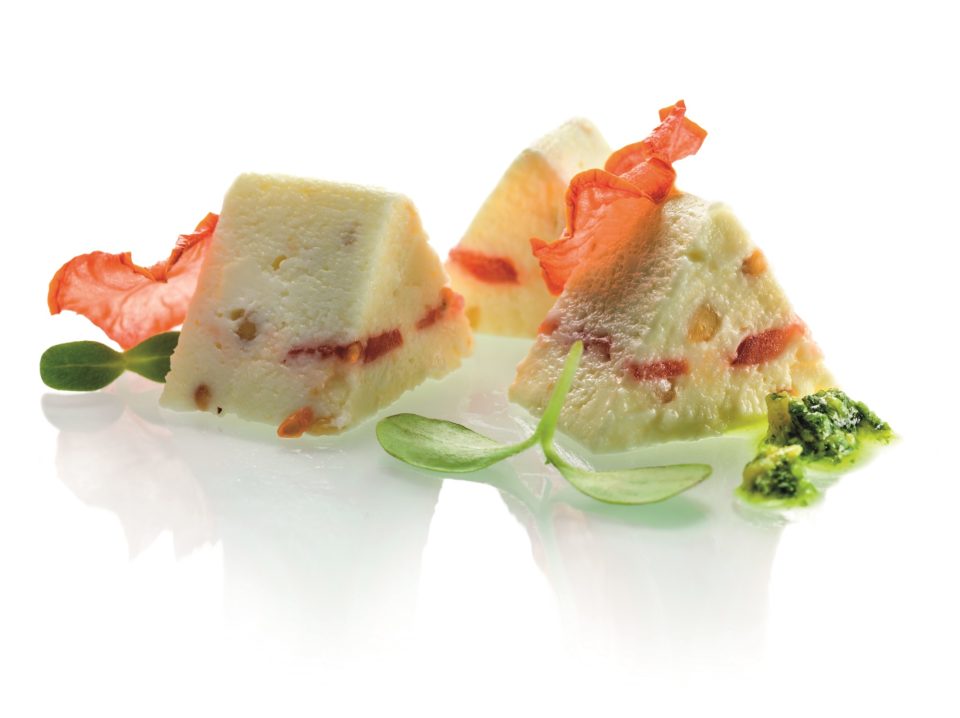
The soft mozzarella or bella napoli is excellent in salads, especially tomato salad, and with pasta, meat, and the Šobska salad. It can simply be prepared with a slice or two of tomatoes, a few olives, sprinkled with olive oil and basil. The image of mozzarella prepared thus is typically Italian, with all the attributes of the Mediterranean cuisine.

Chefs often use it in everyday cooking also as a thickener for sauces and stews; the mozzarella for pizza is an excellent addition (as coating) to various steaks. Together with other ingredients it is an excellent filling for vegetables, meat and other food. Mozzarella for pizza is indispensable for toasted and cold sandwiches; with a slice of good wholemeal bread it can replace an opulent meal in-between.

Mozzarella can be served between main meals as a snack, maybe at surprise visits by friends and colleagues, you can nibble on it when watching TV or during a cosy chat; of course, you can also add it to main courses, especially when they are carefully prepared.
Mozzarella is not only delicious but also decorative food which is often added to dishes in order to make them look better, especially when designing plates with cold cuts and cheese plates for festive occasions.

What kind of drinks to serve with dishes prepared with mozzarella?

The golden rule is that a drink consumed with certain food or cheese must not cover the characteristics of cheese with its flavour. A mild and delicate cheese goes with less aromatic wine without acid. The more intensive the cheese flavour, the more defined bouquet, and because mozzarella is delicate, the wine or any other drink must complement it.

If we are wine lovers, mozzarella will go excellently with a glass of white semi-dry or dry wine, but nothing is wrong if we have it with a glass of red wine. Among non-alcoholic drinks we recommend a less aromatic fruit drink or simply a glass of clear natural water. Beer goes well with mozzarella, especially with the bella pizza cheese, and especially if the cheese is nicely grilled on a pizza.


Ljubljanske mlekarne, mlekarska industrija, d.d. Tolstojeva 63, Ljubljana,
T: +386 1 5881 500, F: +386 1 5881 887
Crtica Customer service Information centre
info@l-m.si, stiki@l-m.si
Crtica News archive Crtica Legal notice Crtica production: Vizuarna